Oh, now we’re getting nostalgic. Taivas Robane and Barus Kuma are the main protagonists of The Nyverian Curse, two best friends who’re seemingly always standing back-to-back against the world. They were heavily inspired by my childhood favourite cartoon show, Swat Kats, where a pair of ex-military rogues work together to make their city a safer place, all the while trying to escape the arm of the law. The vigilantism, teamwork, banter, heroism, and down-on-luck nature of these characters formed the foundation of the design for the Dakusin. They weren’t powerful like Superman, they weren’t rich like Batman, and they weren’t inexperienced like Spider-man.
Something I loved about that show was how the writers balanced the importance of the two protagonists. They needed each other, and were stronger together than they were alone. It wasn’t a hero-sidekick dynamic, but rather that of partners, of equals.
The fact that the double-main character dynamic was done so well set a challenge for me. I strived to capture it, but I won’t know how well I pulled it off without you guys to tell me… wink-wink, hint-hint, nudge-nudge. On a side note, I suppose I have to admit that the ‘arm of the law’ those inspiring characters had to constantly be weary of, personified by a certain stoic commander in the cartoon show, was the inspiration behind Captain Auriol Svard, the arch-rival of the Dakusin. But I’ll get into that another time; I just got the craving to revisit one of those episodes…
The first of the Simon Snow trilogy, the fantastical world of Carry On has a peculiar origin story. Rainbow Rowell’s previous book, Fangirl, explored the fanfiction the main character wrote of a fictional Harry Potter-esque franchise. The popularity of that fictional world’s fanfiction garnered so much interest that it led to its own trilogy—how spectacular; Carry On is a fantasy fiction derived from a fanfiction of a fictional character’s fanfiction of a fictional world based off another fictional world.
Try saying that faster than your mouth abandons you.
The novel reads like a contemporary romance taking place in a fantasy world akin to that of J.K. Rowling’s Wizarding World, without being so similar that one might accuse it of mimicry. It certainly is not the latter; it is a story that holds its own and that has earned its praise.
Full disclosure, it is the first romance novel I have ever read. (except for Far from the Madding Crowd, to be fair). It’s certainly the first queer romance story I’ve ever read. It is complicated—or rather complimented—by a well-done and satisfying love triangle (something that in my opinion is rather rare to find). The outcome is not so predictable, and I was glad that the story kept me guessing all along the ride.
Though the story does start a little slowly, spending perhaps a little too much time depicting the obsessive anxiety our hero feels in the mysterious absence of his nemesis, I am quickly gripped when that nemesis finally shows up. I became so invested in the brewing intimacy between the two main characters—two mortal enemies—that I was racing through the political plot just to see more of it. That’s not to say the political plot was a chore. It was surprisingly layered, introspective, and had its twists and turns, showing you both sides of the coin in a fair way.
The quality of a villain can make or break a story. In Carry On, it holds the story up firmly. The villain (or I should say villains) presents a creepy, mysterious and intimidating aspect to the story. I won’t go further lest I spoil the twists, but needless to say that this is an area the story will not disappoint you with.
A key feature in Rainbow Rowell’s world building in this book was the nature of magic. It really does set it apart from the Wizarding World that she was inspired by. I love the way magic works in the book. Incantations are derived from phrases used by both magical and non-magical people, that hold importance and widespread usage. The more famous the phrase (like, “Clean as a whistle!” or “Up, up and away!”, or even nursery rhymes, which are considered especially powerful incantations), the stronger and more long lasting the spell. Should a phrase or saying fall out of favour, the spell no longer works.
It’s brilliant. Such a unique take on the idea of incantations.
To conclude, I believe that fans of Harry Potter will love it, but so will anyone looking for a fresh take on the magical genre, especially when seeking a good love story which keeps you hooked from start to finish.
If my review left you yearning to learn more, I invite you to visit an independent, more in-depth review that had helped me decide to get the book.
Okay, in the seven years that I worked on this project, never did I seriously consider any other author name than my own. So, why then, in the last phases of the writing, was I going around asking people to help me find a good pen name?
It started when my father asked what I will put as my author name. I replied… and he shook his head. “No, it’s not a good name.”
“What do you mean it’s not a good name? It’s my name!”
“It’s not a good name.”
“YOU gave me this name!”
“It’s old fashioned. Start thinking about a pen name, something that can entice your readers.”
I start doing my research. My mind gets blown when I learn that J.K. Rowling was a pen name. Stan Lee was a pen name too, and I’m on the floor frothing at the mouth. I look further, learn that it’s fairly common practise and for a multitude of reasons.
Among those reasons, yep, marketability. You want something that will appeal to the age group, or whatever demographic you are aiming to sell to. You’re advised to set your ego aside (so I had to find a large enough container pretty quickly), and accept that an alias more catchy, mysterious, romantic, fantastical, etc, will simply do better than your own name.
A friends asks me as I write this: “A ‘container’? Was that enough, really?”
A bit of a bummer, but there was a little fun to searching for a new name. Meanwhile, other advantages came to light, particularly the bit of privacy you get from a pen name. Dreaming of fame and glory is nice and all, but it’s easy to underestimate the dark side of life under the spotlight. I realized I wasn’t overly keen on making it easy to be pointed out by my real name. So, kind of like my childhood idols, I adorned a mask and alias. There’s a fun to it, I have to admit.
I’d have to thank Willow Shire and Dave Chesson for their very nice explanations that helped me make my decision. Have a look at their work if you’re interested in learning more about the process and thinking behind pen names!
Anyone who knows me in real life knows that I am not someone who ever spends a great deal of time on social media. I’m the type of person who knits a close group of friends, who stays away from conflict and controversial issues, and who hates having to type out anything on the phone. Yet… here I am, now juggling accounts on Twitter, Instagram, Facebook, and a website to boot.
I thought about writing about my journey up to this point, for those who might want to listen, or for those who might be following a similar path.
I treated my entry into this online world like a person who dips their toe into a frigid lake. Eventually, it started to feel more like going for a swim on a warm, crowded beach.
It might surprise you that I made it a rule not to invite anyone I knew in real life to follow me as JF Marshal. I had decided that I wanted to keep those two worlds separate. For this reason, I didn’t get to hop on Twitter with an instant hundreds of followers. Though a couple of friends did catch on and manage to track me down, that number has remained the same as of my writing this post.
On that first day when I set up the accounts, I went through what I felt was a mundane task of following celebrities and topics that interested me. Next, I thought, ‘Well, I guess it’s time to say hello and send out my first tweet’. What surprised me was the feeling I got when I got my first follower. Again, this wasn’t a friend or anyone I knew, but just someone who saw the picture of my painting that I posted, and who thought I was worth thumbing the follow button.
Exhilaration. I went to my fiancée and began singing, ‘Honeeyyy I got a follower!’
‘Oh, that’s awesome! Who is it?’
‘Some photographer.’
She replied with a brief bewildered look, but smiled again and cheered me on.
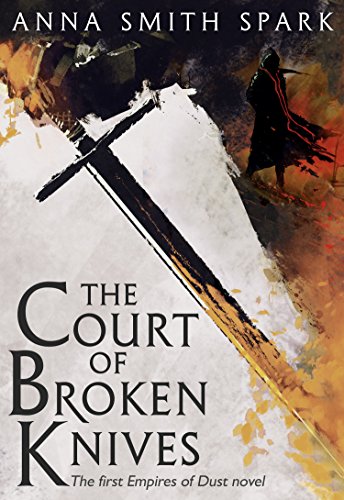
The next ‘achievement’ was to have a celebrity follow me. Anna Smith Spark, the author of The Court of Broken Knives, was that celebrity. She might not identify as one, but I say so since I own one of her books (do you think I have the bar too low?).
Click on the image to find a review on Barnes & Noble
The cover and title was all it took for me to want that book.
Then, I stumbled upon a community. The #writingcommunity was the gateway to an online Shire of writers, I finally found a foothold where I could meet others like me (and very unlike me too—which was equally fantastic), and form a web of relationships in the world of authors. I got to connect with interesting people, learn about struggles akin to mine, and pitch in to help others where I could. A steady stream of new followers came next, who I followed back not only out of gratitude, but also to support their interesting works. To any aspiring author, I recommend you join this community; everyone is welcoming and supportive.
Welp, I think I will leave it here for now. I only wanted to share with you that first couple of steps, and I hope that you liked it.
So I was having a talk one day with my wife, telling her about a dream I had in which I got shot. I mentioned that I felt no pain from the wound, and she replied that she would have been in agony.
It was in that moment I realized that I have never felt pain in my dreams. I would certainly act as if I was, but I wouldn’t feel it. Upon my wife’s reply, I asked her if she felt pain in her dreams, and she said yes.
I then asked her if imagining a needle going into the tip of her finger would—
“Aie!” she said squeamishly, clutching her fingers.
I was fascinated. She was able to imagine the pain so well that she physically felt it.
This is something I cannot do. I cannot create a sensation of pain with my mind, not by imagining an injury, nor by remembering an injury that I actually suffered. Although I can describe the pain I had in the weeks after I had my wisdom teeth removed, and I can remember the difficulties in breathing and sleeping when I had broken ribs, what I absolutely lack is the ability to imagine or remember the pain itself.
Very quickly, I realized pain was not the only sensation that I was unable to mentally recreate. I asked my wife if she was able to smell or taste in her dreams, and she replied that she could do both. I have had dreams where I am eating something, but I never recalled tasting anything. Even when I am awake, I do not have the ability to imagine a smell or taste! This hit me like a train, because my wife did have the ability.
If I asked her to imagine a slice of orange hovering in front of her nose, she could imagine the tangy smell. If I asked her to remember the taste of her favourite sweet, her expression would turn into one of bliss as if she were having the sweet that very moment.
I ran further tests. I noted her disgust and pleas for me to stop when I started listing horrible stenches. Professional jealousy.
All this prompted a question: was she the weirdo, or was I? Was I sensorially handicapped, or was she sensorially gifted?
Before I answer that question, I want to briefly mention the other senses we tested:
Sight. Both of us can picture things in our head, as we imagine most people can.
Hearing. Both of us can imagine the shatter of glass against stone, or a verbal conversation. We can both remember and play music in our heads, and create sounds that we don’t usually hear in our day to day lives.
Temperature. Both of us can imagine heat and cold (although I cannot imagine the extremes that lead to pain, such as touching boiling water).
Touch. Both of us can imagine the rough surface of tree bark, or the softness of a cotton ball. This is actually an interesting one to me, because although I cannot imagine the taste of a slice of orange, I can easily imagine the feel of it in my mouth, the velvety surface, the burst of cold juices upon a bite, and the chew of tough fibery husks.
We decided to ask family and friends.
With our sensory memories detailed, we decided it was time to ask friends and family. Would one of us turn out to be special?
What an interesting enterprise. Oh, how satisfying it was to see everyone we ask learn about this, as if they too were only realizing these things for the first time.
The answer became apparent: my wife is not gifted, and I am not handicapped. We noted that a full spectrum of ranges was surfacing with every person we quizzed. There were certainly more common patterns appearing, but also several unique ones.
By far the most common senses people had mental access to were sight and hearing; it was no surprise. However, there were a couple of interesting outliers:
JM described the ability to hear sounds in his head, but only if they were from memory. That meant that he was unable to imagine a friend saying something if it wasn’t from a recollection. He could play music in his mind, but could not alter its pitch, rhythm, or lyrics in any way. JM was the first person apart from me who also had a hard time imagining the sensation of pain.
MC is by far the most unique person interviewed. She is unable to imagine any of the aforementioned senses, including sight and sound. She cannot picture a flower in her head, nor its colours, nor recall music. To draw a lion she would require a model. To draw a shape, for example a triangle, she works off of the knowledge that a triangle has three sides. She does dream though, but the dreams are pure ‘emotion’, as she would describe them.
This prompted a question: can we imagine emotion? It turns out that my wife and I, as well as JM can. This could be an additional sense to add to our little quiz.
To my relief, I was not alone in my inability to imagine smell and taste. My best friend was the same, and he certainly made clear his anguish when he realized this ‘handicap’. He would have preferred to live his life blissfully unaware of the fact that he was, as he put it, ‘missing out’.
I apologize in advance to any reader of this blog who might feel the same way…
Several of our family members had some mixture or the other of sensorial memory. Some unable to recall taste, but able to recall smell, or vice versa, and others able to do both or neither. The other senses varied among the responses as well. One friend vividly described his dream of being mauled by wolves, and feeling the pain. He looked at me resentfully as I described that I wouldn’t know what it felt like.
My Collaborator: Sciathlon
I have worked in collaboration with another blogger for this subject. If you would like to learn more about scientific research into sensory memory, please visit Sciathlon! She
Want to join the fun?
Perhaps you would be interested in contributing to my research (mad scientist giggle in the background). I have a survey prepared for anyone who would like to share their sensory range, here:
It’s a simple quiz that can be filled out in 60 seconds. I bet that you’ll find it fun, so be sure to share it with family and friends! The results will be posted on both my blog and Sciathlon’s.
Sciathlon: “When we have a gathered data from a statistically significant number of participants.”
Me, sighing: “Yeah, yeah…”
This topic affected my writing.
Upon discovering all this, I realized something important about my writing. Since I cannot easily imagine tastes or smells, I had a tendency to leave out those senses from my prose.
I mean, it makes sense doesn’t it? You write what’s in your head, and I didn’t have two senses available to draw imagination from.
I realized that those people, like my wife, who are capable of imagining those sensations so vividly, would be missing out on a feast of feelings due to my writing. What a sobering thought… and it drove me to action.
I began to make mental notes of every smell and taste I could. Every sip of champagne, I made effort to commit it to memory. Though I could enjoy the taste and smell in the moment, I would soon after be unable to recall them, but I would have the notes of my experience.
It helped to expand my vocabulary, for example reading reviews of professional tasters, or browsing lists of words used to describe various scents and tastes.
So, with these new strategies, I wrote a scene where a character is sipping champagne and was able to describe the sight of amber, the whisper of effervescence, and a toasty scent, the crispy taste of apples.
And though reading my own written words wont always give me the pleasure of enjoying a scent or taste, at least I can rest easy knowing that my readers will be able to benefit from it…
Lithe nodded as she poured the champagne. Crystalline, liquid gold swirled and sparkled in the glass. When she was done, the sound of effervescence took over the silence, emanating from the two glasses the djinn now held in her hands.
“Champagne?” She offered, her eyes shining in the firelight.
Taivas couldn’t help but take it. “Yeah, why not?” He took a drink in his hand. It was cool to the touch, and a mist was forming on the inside of the glass over the layer of pearly mousse. It whispered softly as tiny bubbles darted up like shooting stars. The sheer tempting beauty of it was distracting.
A toasty, slightly spicy aroma filled his nose as he tilted the tall glass and took a sip. It was immediately crisp in the mouth, and a sizzling, acidulous taste of apples washed down his throat. The fragrance lingered long after his lips had left the glass, and his palate was still tingling as he uttered, “…Holy shit.”
An excerpt from The Nyverian Curse, Chapter Two (modified to hide spoilers 😉)
I wanted to take a moment to talk about the way I describe certain physical features of my important characters. It was something I always had a little fun with, so I’m hoping you might have some fun hearing about it.
First, I should say that I don’t go into great detail when describing my characters. Here are three reasons why:
1 – I felt like it tended to break my flow, the rhythm of the scene where I was introducing them, if I spent too much time on it. I always tried to keep it to a few sentences at most.
2 – Readers have excellent imaginations. That’s why they are there in the first place, to find something to feed that amazing engine in their minds. They are your collaborators. They’ll take your sentence (say, “A man walks into a bar”) and instinctively fill that world all by themselves. In a way I let the readers each form their own version of the character, rather than imposing every detail on them as I saw it in my head. HOWEVER, what they fill it is lifeless in comparison to what you can provide. It’s a scaffold. You can enrich their senses, give them more to breath in and forge in their minds.
With all this in mind, there are absolutely features about a character that the reader should be told, to enhance their image of them. That’s where number 3 comes in.
3 – Sometimes less is more. A few striking features that you bring up multiple times will do more to make a character memorable than a lengthy description that will only be seen once in the story. An excellent example for this is in JK Rowling’s work. Umbridge? Toad faced. Harry? Messy hair and round glasses. Snape? Oily black hair, etc… If a character is memorable for just one quality, it’s memorable enough.
Now, let me share some of the thought that went behind a couple of characters in The Nyverian Curse. They say the eyes are the windows to the soul. I showcase that. Always, the way I describe an important character’s eyes should tell the reader something about them, albeit in a symbolic sort of way.
One of the main characters, Taivas Robane, has eyes that are ‘orange like hot metal’. It’s one of my favourites. It speaks of energy, malleability, and temperament. Can you feel the heat radiating out of his eyes when he gets angry?
Let’s look at Eistas. Ah she was such a pain to choose for. God. Seriously it took a while to decide. I still hesitate. Sometimes. Anyway, her eyes are described as ‘blue-grey, like the pebbles in the river’. Eistas was living in this forest for most of her life, it seemed natural that the forest itself—in this case the pebbles in the Marble River—should be part of her very look. She’s a character with both innocence, and darkness. She’s dynamic, constantly flowing, but steady in her own way. The mixture of stone and water, and the added cute/plafulness-factor in the word ‘pebble’ and the mysterious power in the word ‘river’, shape her into a character with plenty of depth. Like a river!
I hope that my two cents on the topic was interesting, and that you’ll discover some of the thought that went into that little touch…

 JF Marshal